Practise the thinking. Keep the judgement.
What is a haiku? Learn through three examples
Haiku means a short Japanese poem, written 俳句 and pronounced はいく (ha-i-ku). Its traditional basic pattern is 5–7–5: seventeen Japanese morae. As you read, notice the season, concrete details and pauses as well as the count.
You may have met the word in an English class, while learning Japanese or through a famous poem. Start with the form and examples below: picture the scene, then consider how so few words can leave a lasting impression.
Count morae, not written characters
Japanese poetic sound counts are usually understood as morae, or rhythmic beats. They do not correspond directly to Chinese characters or English syllables. 俳句 has two written characters but three morae: は・い・く. とうきょう has four: と・う・きょ・う.
- ん and the small stop marker っ each count as one mora.
- A long vowel adds a mora: とう has two.
- A combined sound counts as one: きょ is one mora, so do not count the small ょ separately.
For example, 古池や is ふ・る・い・け・や: five morae. Translations help you understand the poem; they need not force its rhythm into a 5–7–5 count. English-language haiku do not all use seventeen English syllables.
Season words and cuts: making room for a response
Kigo: placing an image in a season
A kigo (季語/きご) is a word associated with a season, such as spring rain or summer grasses. Traditional classifications have cultural and calendar histories; they do not necessarily describe the weather where you live. Consult a saijiki (歳時記), a seasonal-word reference, when unsure.
Kireji: giving the reader a pause
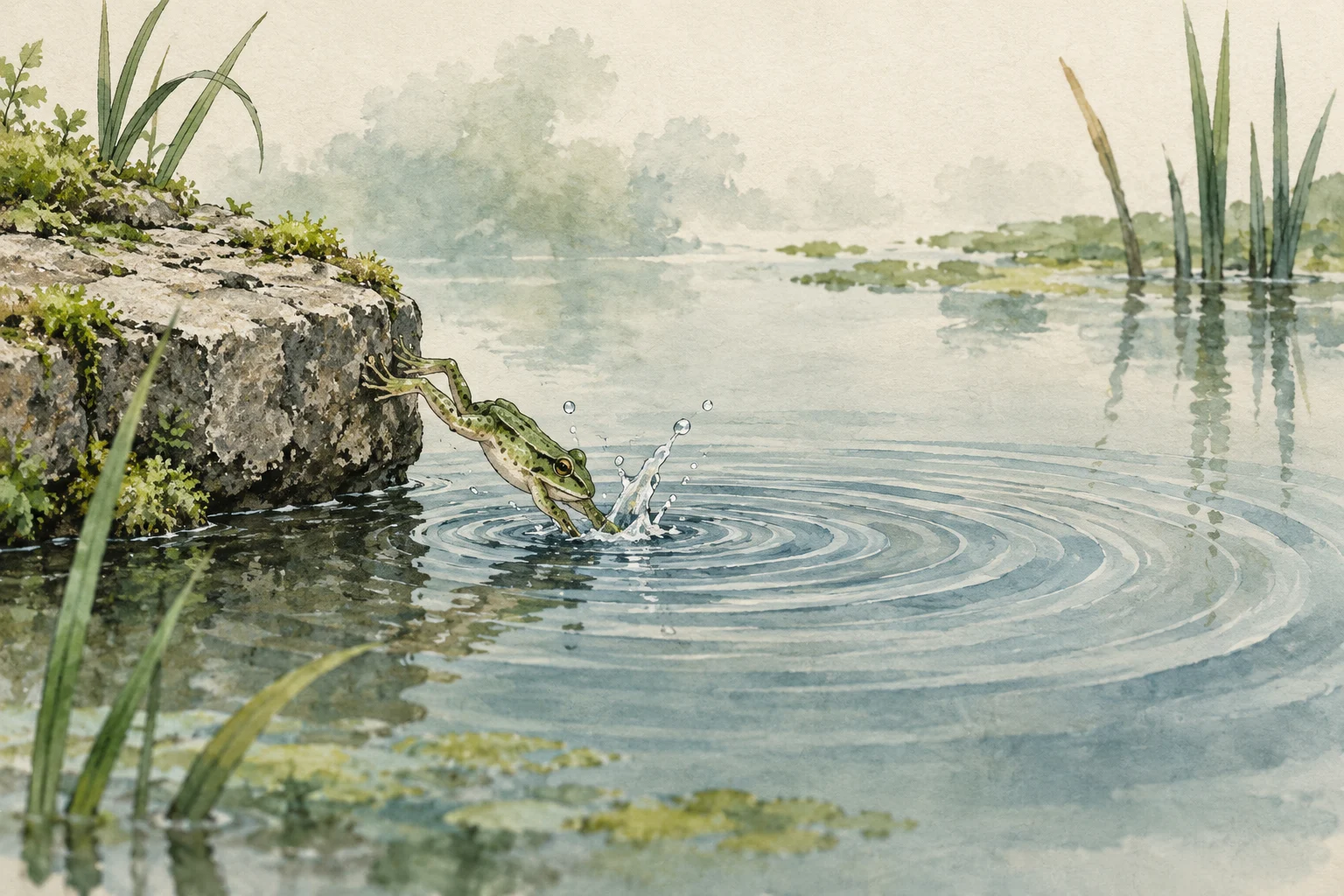
Cutting words (切れ字/きれじ) such as や、かな、けり can create a pause, exclamation or close. The や in 古池や lets the pond image settle before the sound of the frog entering the water. There is no single fixed translation: a dash, tone or sentence rhythm may convey the effect.
This is an introduction to traditional haiku. Modern schools vary, and not every haiku strictly keeps seventeen morae, a season word or an explicit cutting word. Nor does a departure from 5–7–5 automatically make a poem senryū.
Three haiku examples: Japanese, kana and meaning
The prose translations below are original RubricMark renderings, not quotations from published translations. Line breaks show the rhythm and kana supports reading aloud. Classical texts may use different written forms in different editions.
1. The old pond and the frog: listen closely
Matsuo Bashō · 1686
古池や
蛙飛びこむ
水の音
ふるいけや / かわずとびこむ / みずのおと
ふ・る・い・け・や(5)
か・わ・ず・と・び・こ・む(7)
み・ず・の・お・と(5)
Meaning: An old pond— a frog jumps in; the sound of water.
The frog, 蛙, is a spring season word in traditional saijiki. Here it is read kawazu, rather than the everyday kaeru. や leaves a pause after the pond, followed by the sound of entry. You might read a contrast between a still scene and a sudden sound. The poem does not state “I feel calm”; the images invite a response.
Think about it: If you removed “the sound of water” and only said “a frog jumps into a pond”, what would be lost?
2. Summer grasses and old dreams: the present meets the past
Matsuo Bashō · The Narrow Road to the Deep North
夏草や
兵どもが
夢の跡
なつくさや / つわものどもが / ゆめのあと
な・つ・く・さ・や(5)
つ・わ・も・の・ど・も・が(7)
ゆ・め・の・あ・と(5)
Meaning: Summer grasses— the traces of warriors’ dreams.
夏草, summer grasses, is the season word. 兵 is read tsuwamono here and means warriors. At Hiraizumi, Bashō placed the grasses before him alongside the warriors’ past. A common reading treats 夢の跡 as the remains of earlier ambitions; the linked commentary also suggests a dream encounter with spirits, drawing on Noh theatre. Keep the dream image in view and compare the historical clues behind each reading, rather than rushing to a single moral.
Think about it: Which part is visible in the present, and which part takes you into the past?
3. Try writing a moment from your own surroundings
Original RubricMark practice example · Not a classical poem
春の雨
傘をたたんで
門くぐる
はるのあめ / かさをたたんで / もんくぐる
は・る・の・あ・め(5)
か・さ・を・た・た・ん・で(7)
も・ん・く・ぐ・る(5)
Meaning: Spring rain— folding the umbrella, I pass through the gate.
春の雨 names the season, followed by the specific actions of closing an umbrella and passing through a gate. This practice poem has no cutting word such as や, かな or けり, and does not state the person’s mood. Observe a moment, then try to retain it in concise language. Reaching seventeen morae is only the start of practising the form.
Think about it: Replace an action with a small movement you have observed. Write your version, then read it aloud to check the morae.
How do haiku, tanka and senryū differ?
| Form | Traditional basic pattern | What to notice |
|---|---|---|
| Haiku | 5–7–5 | Season, close observation and a cut; modern approaches vary. |
| Tanka | 5–7–5–7–7 | Five rhythmic phrases. The waka in the Ogura Hyakunin Isshu use this form. |
| Senryū | Usually 5–7–5 | Often human behaviour and humour, usually without a required season word. Subject or count alone does not settle every boundary. |
When you see a short poem in three lines, examine its language, rhythm and expression. Chinese five- and seven-character quatrains have their own conventions; brevity and nature imagery do not make them haiku.
A way to practise your first reading
- Describe the scene. Say what you see or hear in your own words before seeking a standard interpretation.
- Find the clues. Mark season words, actions and pauses. Separate what the poem states from your associations.
- Compare the expression. Rewrite the poem as an ordinary statement, then return to it. What do rhythm, gaps and specific details change?
For 古池や, begin with “pond, frog, sound of entry”. Then ask: which word explicitly says “quiet”, or am I inferring quiet from the sound and pause? This helps you distinguish textual evidence from your interpretation.
Common questions about haiku
What is a haiku?
Haiku is the romanised form of 俳句 (はいく), a short poetic form originating in Japan. Its traditional introductory pattern uses seventeen morae in 5–7–5 and a season word. Concrete images, sounds and pauses often bring a moment into focus.
How do you write a haiku?
Begin with something you have observed, select a suitable season word and shape concise Japanese into 5–7–5 morae. Read aloud to check the pause and images, rather than padding the count with adjectives. For English or Chinese writing, state the convention you are following: Japanese morae are not English syllables or Chinese character counts.
Must a haiku have three lines and rhyme?
No. Japanese haiku are often written in one line or vertical column. The three lines here make the rhythmic phrases visible. Rhyme is not required. 5–7–5 is the traditional basic pattern; variations include extra or fewer morae and free-form haiku.
Is the Hyakunin Isshu a haiku collection?
No. The Ogura Hyakunin Isshu contains waka in the 5–7–5–7–7 form usually called tanka. Traditional haiku use 5–7–5. Both reward reading, but not all short Japanese poems are haiku.
Sources and further reading
- The Haiku Foundation: What is Haiku? — English-language haiku, cuts and differing definitions.
- Matsuyama’s introductory haiku guide — 5–7–5, season words and observation exercises.
- Idemitsu Museum of Arts: the old-pond verse — the original text and sound imagery.
- nippon.com: summer grasses — Hiraizumi and interpretations of Bashō’s verse.
Historically, these poems by Bashō were hokku, opening verses within haikai. Introductory guides today often present them as haiku classics; this article follows that familiar teaching convention.